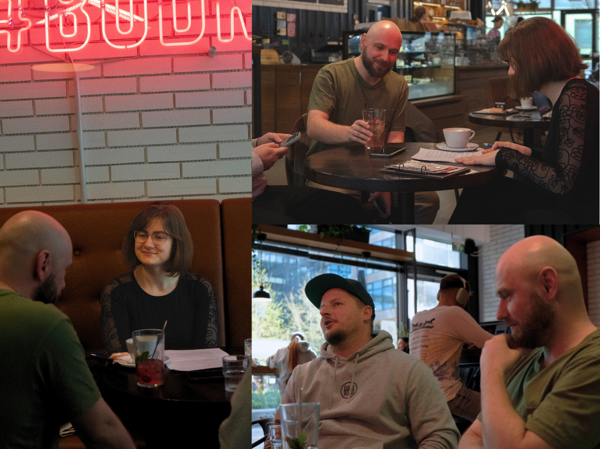
PSSST! Do you want to know where the legendary cyclo-heroes Aura Blazer, Coral Bubble and Rockeeon came from? How is a comic book character created? And how is it made to move so that it can wave at you? Graphic designer Yvans and animator Jaro Adamuščin will reveal the secrets of the cartoon superhero world!
Share
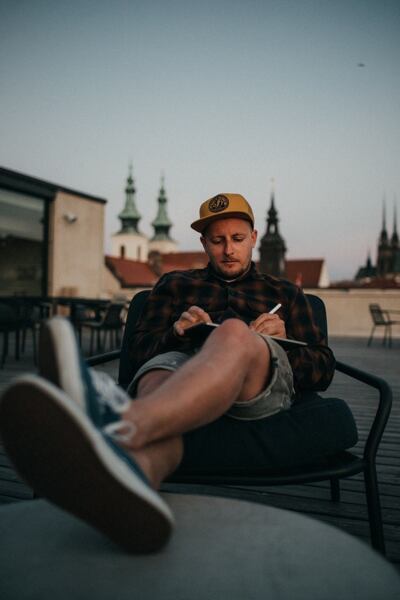
photo: Kateřina Barvířová
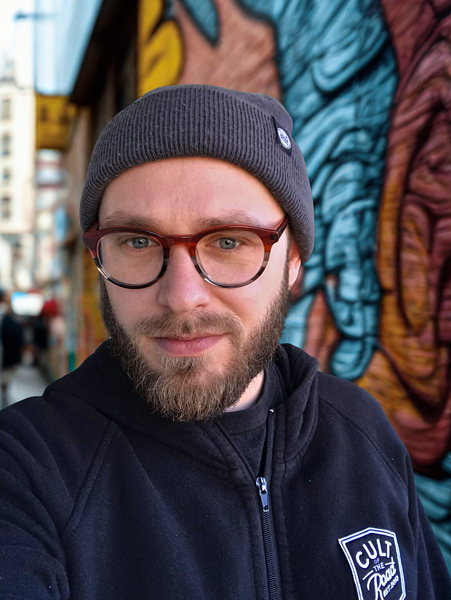
Yvans: graphic designer, illustrator
My real name is Ivan Svárovský – co-founder of the clothing brand Cult of the Road inspired by skate culture and modern urban art, member of the art association of professional artists called Projekt JZD and Brňák jaksepatří. Proud author of the comic superheroes FÍHA and cartoon graphics on the brand's website.
Jaroslav Adamuščin: animator, Multimedia Specialist – Advisor
Jaro comes from eastern Slovakia, but has been a proud Brno resident for 12 years and the father of one-year-old Dorotka. He is dedicated to creating educational videos. You may also know him under the pseudonym Mental Disorder, under which he mainly does 2D animation. And he is great at it – by the way, you can judge that by the video on our homepage.
Our secret sources have found out that you have worked together in the past. How did it all start? And how do you work together – are you a perfect duo?
Yvans: It definitely started with Focus Fest.
Jaro: I think it's been six years since we've collaborated on the theme song that plays before every film at the festival. Yvans does the graphics, and I animate it. It's kind of a tradition for us.
Yvans: We each have a slightly different workflow – so even after years we are still fine-tuning it (laughs). But as for FÍHA, it really worked out well for the first time. When two people focus on the same thing, there is a benefit.
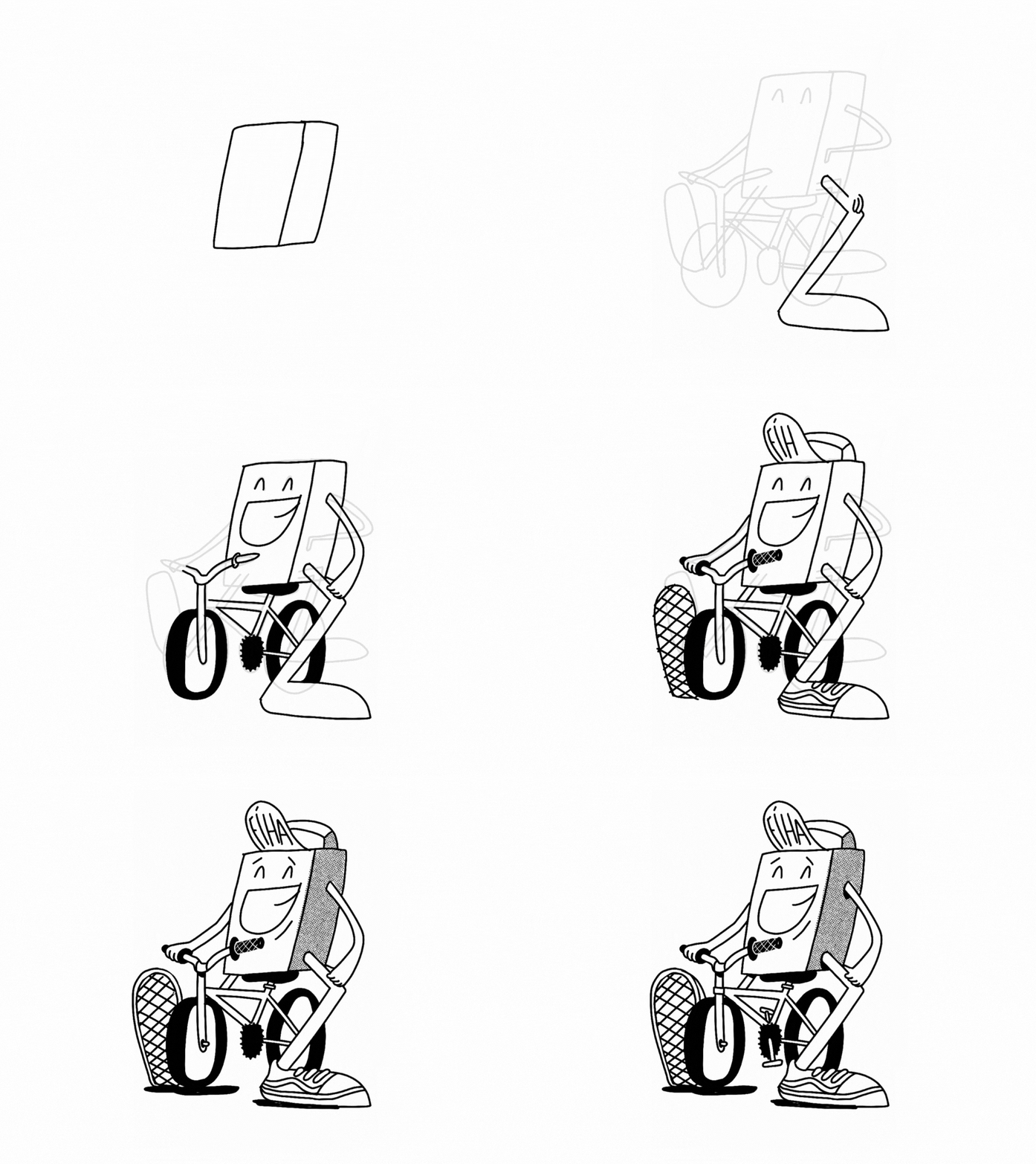
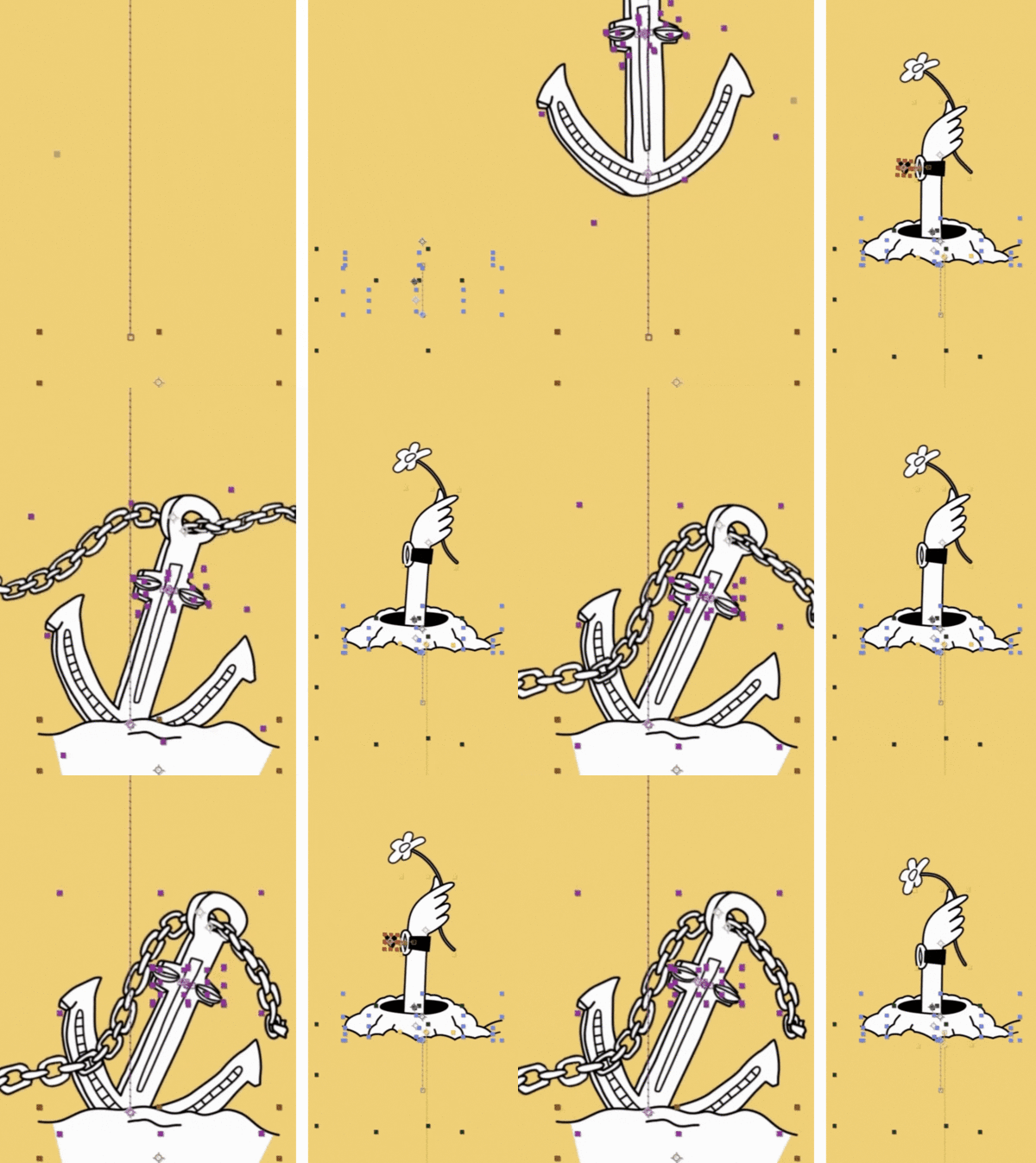
Jaro: That's right. When we started working together, it was a bit of a learning curve (laughs). We needed to combine two different worlds: graphics and animation. Yvans had no idea at the beginning how I would want to prepare the graphics so that they could move: each image must have individual layers, which I then move one by one in Adobe After Effects. For example, if we want to move a hand, we need to draw it separately.
Yvans: Exactly – I actually create the characters like puppets. Jaro has a bunch of trendy animations under his belt, so he knows exactly what the graphics should “do” to make them look funny and interesting.
Jaro: It took a lot of communication, but today we are a well-coordinated duo that complements each other – and I always look forward to working with Yvans. He is one of the top graphic designers in our country, and good animation cannot be created without good graphics.
How did the cartoon world of FÍHA gradually come into being?
Yvans: I was the first to design superhero images for the boxes in which the bikes would arrive to customers. So we ended up with three separate scenes with the heroes set in a cartoon world. It was great that we didn't have any crazy deadlines, so we could plan everything out nicely and work with more perspective. At the same time, we were given quite a bit of free rein, which I'm really grateful for.
Jaro: Yvans is actually my input – he has to provide me with graphic elements, and then I animate them and continue working on the animation. When I create an animation, I first prepare the environment – I set the scene in motion, adjust its foreground and background, and set the speed so that it looks realistic (for example, pedaling a bicycle so that the boy is not going too fast or too slow compared to the surrounding environment). In the video, I also wanted to show that the scene has depth (so-called “parallax”). This means that when you focus on the objects in the front, they move faster than those in the background. Only then do I add moving characters to the empty scene. Of course, Yvans and I continuously discussed and approved the entire process with the management of FÍHA.
How is a comic book character created? Ivan, will you take us "behind the scenes"?
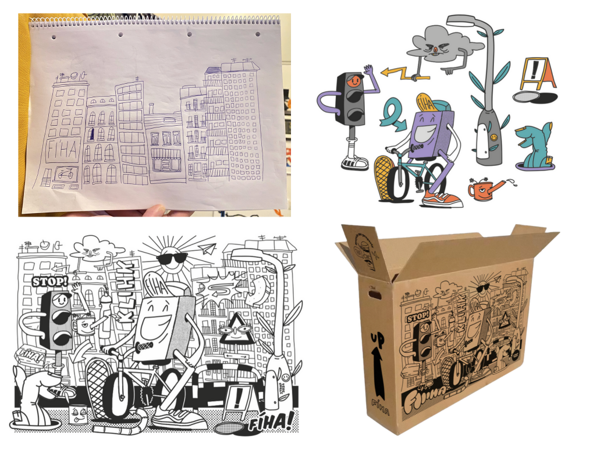
Yvans: I find a pattern that I want to work with (usually together with the client): that means the style of drawing and the way it can be worked with. It is then up to me to combine these two things. First, I sketch the character and the environment around it with a pencil or pen on paper. I transfer what I like to the tablet. Then we usually coordinate the details with the client, for example, looking for the ideal expression for the mascot. Gradually, let's say two main versions are selected, which are tested in different situations (surprise, frown and other facial expressions). Then the final version of the character is selected and I convert it into vector graphics.
What inspired you when creating the FÍHA characters?
Yvans: I was tasked with designing superheroes on bikes. But they certainly didn’t have to be human heroes, which was very liberating – you can afford more things. FÍHA superheroes are inspired by distinctive shapes with features that give them an advantage in a given environment. Aura Blazer is a nimble street hero inspired by the shape of a city building. Rockeeon is a more robust outdoor superhero in the shape of a tent or mountain, and Coral Bubble is a bubble that fits perfectly into the water world. We talked a lot about how it doesn’t really make sense (laughs) – you can’t ride a bike underwater. But we’re creating a children’s world, right?
Do you have a favorite among the characters? Has one of them become close to your heart?
Yvans: It will probably be the first one I drew – the city hero Aura Blazer. It was my first illustration that reflects the style of FÍHA – the others then adapt to it. And it’s also because for me personally, it’s most natural to move around the city on a bike. Then, I also like the jumping traffic light from the characters. Honestly, FÍHA is one of the best projects I’ve worked on in years – and I’m looking forward to it all being “out there”.
Jaro: I have to add that I really like the cool fish with cycling glasses in the water world. It only swims there for about two seconds, but as soon as Yvans sent it to me, I said to myself: that fish is really cool! I have to put it there! (laughs)
Do you enjoy creating children's cartoon worlds? What do you enjoy about it, what is interesting about it?
Yvans: I like that there are no rules. I can invent a whole new world that has its own: for example, a blue sun or a banana that is bigger than a person. I love Adolf Born. He is the first illustrator I remember from my childhood – precisely because he doesn't follow any rules when creating his cartoon worlds. Thanks to him, I decided that I would like to do illustration in exactly the same way one day.
Jaro: You described it well – there are no boundaries, we can do whatever we want and there is a lot of room for creativity. Children's animation does not have to be technically precise and complex – it has to enchant children. It should be as varied as possible, but at the same time simple, and mainly show expressions and emotions, astonishment and so on. And at the very end, I enjoy seeing the children's reaction: when I was working on the video for FÍHA, my one-year-old daughter was constantly following me to the computer – she always wants to see what I am animating. I sat her on my lap and played the animation for her. And she was completely blown away by it: she sat, laughed and banged her hands on the table the whole time.
Let's talk about our intense introductory video. Readers have no idea that the young cycling hero is filmed in a studio, riding on spinning rollers. Jaro, how was the filming?
Jaro: Filming the boy on the bike was a challenge for me and my team – when you film on a green screen and the wheels are spinning fast, the spokes can completely disappear from the shot. Neither my team nor I had any experience with anything like this before, so we were worried that the filming would turn out the way it should.
I didn't know how well the boy could ride a bike or what the slowest speed he could go without blurring the spokes. I was also worried about the lighting conditions in the studio. Then I started to realize that the boy needed to make some kind of face every now and then, to act and interact with the environment in the video. I started to guide him when to point, when to laugh, or when to look around.
Behind the scenes from the filming of the FÍHA opening video on green screen
And how did the filming go for our cycling hero?
Jaro: When the boy came to the studio with his father, he had an accident and was wearing a collar around his neck. That's why I always asked him before every activity if he could handle it, so that nothing would happen to him. His father knew what he could do and was able to motivate him well. For our part, we tried to maintain a pleasant atmosphere in the studio so that he would perceive us more as friends, rather than coming to a formal environment among strangers: we had music playing in the background, there was light refreshments and pleasant lighting on site.
The boy's filming went beyond my expectations – I had no idea how much he could do on the rollers! With regular breaks, he managed to ride for about an hour and a half in total, with one shot lasting 30 seconds. I had only seen the rollers in a photo before filming, so I couldn't imagine what it was like to ride them. A colleague of mine, who rides a lot, and I tried it ourselves: we couldn't keep up with his pace, we fell off after about three seconds. The boy had been practicing riding the rollers at home with his dad for a week or two, so he was already trained – and I admire how much he lasted.
Tip: How many pictures did you need to draw to make the entire animation move? And how long did it take to create it?
Yvans: For each world the boy travels through (city, water realm, nature), about 30 illustrations were needed – so there will be about 90 to 100 images in total. From the big, main ones, to a small note or flower flying somewhere in the background.
Jaro: I spent about 100 hours on this animation. I'm counting all its versions and variations: portrait for social media, landscape, looping for the web, and so on. The scene was more complex, and the more elements it has, the slower it plays in the program. And when I animate something, I often look at one second, maybe 30 times - I want it to be perfect.
Now let's get started. Do you like cycling? What does cycling mean to you?
Jaro: I really like bike trips – I definitely see more than if I went for a walk. For me, cycling means the freedom to go wherever I want. And also to meet up with friends quickly. Every year, a friend organizes a bike birthday party – we plan a route, take the train somewhere and then go for a “bike ride”. In short, such relaxing rides, no extremes – and in the future I look forward to riding with my daughter.
Yvans: I also like to ride, especially in the summer. For me, a bike is the ideal means of transportation for moving around the city. In every larger city, it is becoming increasingly difficult to move around differently. I started riding after Covid, it was a trend that also affected me. About ten years ago, I bought a fixie, a city bike at Cyklospeciality, on which I was able to ride all kinds of long-distance routes. But now, years later, I decided to buy a gravel bike, so I'm looking forward to this season when I won't be so limited by the track profile and can venture into more challenging terrain.
In your opinion, what are the benefits of cycling for children?
Jaro: Well, first of all, it's exercise, sports. I see an advantage in it for me too – the little one will be able to go on trips with us soon and we won't have to drive. So fresh air, a trip, shared experiences and exploring nature and the surrounding environment.
Yvans: Maybe some responsibility. Children learn to perceive their surroundings and pay attention to what is coming from where.
And finally, the most important thing: what do you think about the FÍHA high-density children's bikes?
Jaro: I like that they are so "cute". That they are simply childish, created for children. I also like the colors: purple, red, blue... They are so pretty, everyone can choose from them.
Yvans: I like that there is a story behind it. The "fairytale" style is close to children and can help them fall in love with cycling.
WHOOSH! The holidays are coming to an end, but don't park the hell machine just yet. From August 13 to September 13, 2026, you will receive a free book, Lev Alex frčí na kole (The Lion Alex Rides a Bike), with every FÍHA children's bike. So put on your helmet, put your hands on the handlebars, and let's go for the next mission.
CLICK! The helmet buckle clicks. SNAP! Little hands grip the handlebars. Are you ready? The little bike hero bounces off the ground. The pedals slowly spin. It looks uncertain for a moment… but then suddenly — ZOOM! The road beneath the wheels comes to life and the adventure can begin.
We use cookies for the proper functioning of this e-commerce shop, to adapt the site content to your needs, for statistical and marketing purposes and to personalize advertisements from Google and other companies. By clicking "Accept All", you consent to their collection and processing, and we will provide you with the best shopping experience.
Your cookies settings
Here you can enable cookies according to your own preferences.You can change those settings any time in the future by clicking 'Cookie settings' link in our website's footer.
Necessary cookies help make a website usable by enabling basic functions like page navigation and access to secure areas of the website. The website cannot function properly without these cookies.
Preference cookies enable a website to remember information that changes the way the website behaves or looks, like your preferred language or the region that you are in.
Statistic cookies help website owners to understand how visitors interact with websites by collecting and reporting information anonymously.
These cookies are used by advertising and social networks, including Google, to transmit personal data and personalise ads to make them interesting to you.